

Executive Summary: Building a skincare routine recommender requires more than just code; it requires structured, reliable data. This guide demonstrates how to implement ingredient-matching logic in Node.js using normalized metadata. We show you how to filter products by ingredient function and safety ratings (with the right dataset).
The value of a skincare application lies in the ability to recommend the right product. However, the quality of your output depends on the structure of your input. Here is how to build a robust routine-builder logic in Node.js.
The Architecture of a Routine Engine
A skincare routine algorithm is, at its core, a filter-and-map function. You match user skin concerns (such as acne-prone skin) against product ingredient properties (such as comedogenicity scores). For the backend, Express is a common choice for the API layer, paired with Mongoose or Prisma to interface with your database. On the frontend, React or Next.js are well-suited to rendering recommendations dynamically.
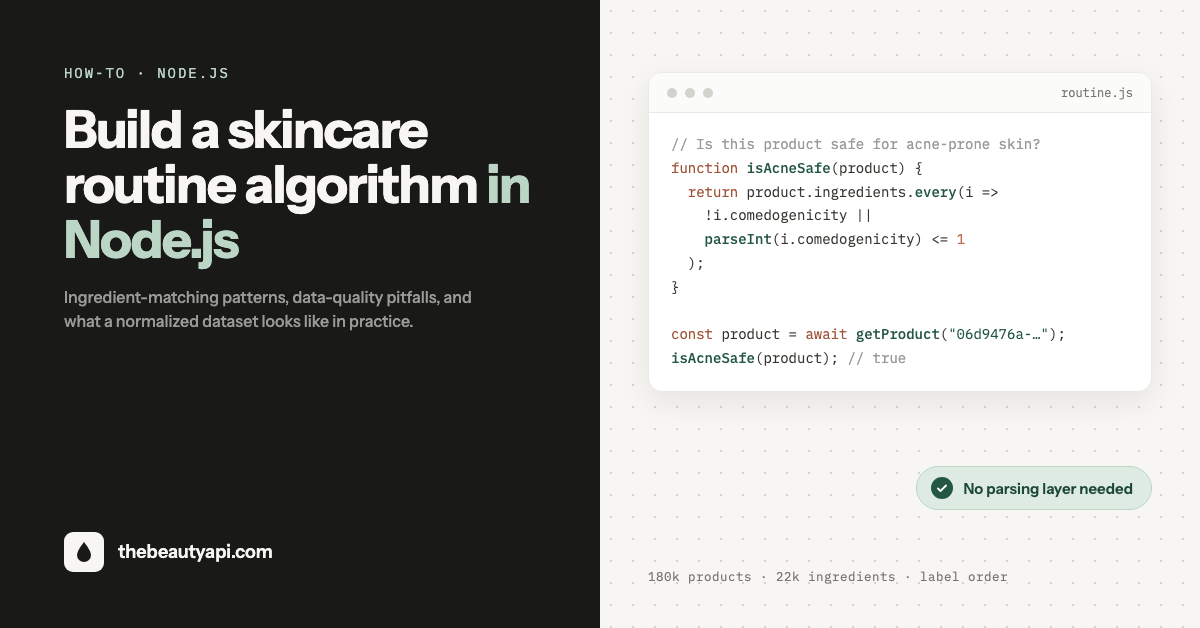
Here is a simplified example of how you might query a product with The Beauty API to check if it is suitable for an acne-prone user:
// Helper to check if a product is acne-safe
function isAcneSafe(product) {
  return product.ingredients.every(ingredient => {
    // Filter out any ingredient with a comedogenicity score > 1
    return !ingredient.comedogenicity || parseInt(ingredient.comedogenicity) <= 1;
  });
}

// Usage with a normalized dataset record
const product = { /* The Ordinary Niacinamide 10% + Zinc 1% data */ };
const isSafe = isAcneSafe(product);
console.log(`Is this product acne-safe? ${isSafe}`);
Why Messy Data Breaks Algorithms
The code above relies on the assumption that the comedogenicity field is a standardized, clean integer. If you use crowdsourced data, you would likely face a data-wrangling problem instead:
// The data-wrangling nightmare
function isAcneSafe(product) {
  // You have to manually parse strings, handle typos,
  // and deal with missing keys that are not standardized.
  return product.ingredients.map(ing => {
     // This list would need to be thousands of lines long
     // to account for non-standardized naming conventions
  });
}
Building an algorithm on top of messy data forces you to become a data cleaner rather than a product builder. What you want is a normalized, INCI-mapped dataset where the ingredients list is already resolved to a single, structured object.
Scaling Your App with The Beauty API
The Beauty API provides one such structured foundation for moving from prototype to production. With ready-to-use arrays of ingredient functions, safety ratings, and standardized aliases, you can focus on the user experience rather than data parsing.
- Production-Ready Schema: Every product includes an
ingredientsarray with functional classifications, making it easy to filter byantioxidant,exfoliant, orsolvent. - Asset Management: An accompanying image archive removes the need to source photography or map URLs yourself. Use the
image_nameID to render product images directly. - Developer Velocity: When your data is already clean, your Node.js backend logic stays lightweight and performant.
The Bottom Line
Your algorithm is only as good as the database behind it. Avoid building custom parsing logic for data that will not be production-grade. A professional, normalized dataset lets you launch your skincare routine recommender on day one.