

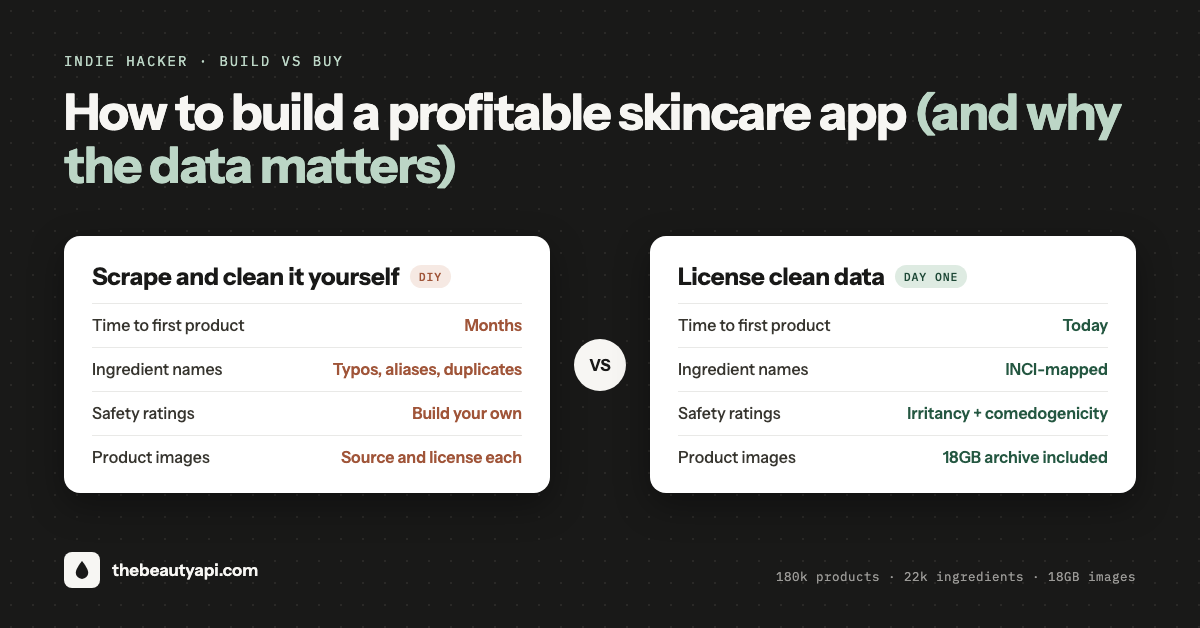
Executive Summary: Skincare apps are highly lucrative. Completely bootstrapped apps like Yuka are hitting $12M ARR. But any technical founder worth his salt will know that the real barrier to entry is not coding the app; it is sourcing clean data. Here is how leveraging a normalized dataset like The Beauty API lets you bypass months of data wrangling and launch a profitable app in weeks.
If you follow the indie hacker scene on X, you know that niche consumer apps are quiet cash cows. Skincare and beauty tech apps, in particular, are absolute goldmines. Just look at the bootstrapped app Yuka, which recently crossed $12M ARR without raising a dime of venture capital. OnSkin, another independent player, is sitting on millions in estimated annual revenue.
Why? Because skincare users are highly motivated. They check ingredients religiously, and they stick around for the long haul. The monetization whether through premium subscriptions or affiliate links basically runs itself once you have established trust.
The Moat is the Data, Not the Code
When I talk to app developers trying to enter the space, they realize the coding part is trivial. Knocking out the frontend in Swift takes a few weekends of focused (vibe) coding. The actual nightmare is the data.
You cannot just scrape a few websites and call it a day. Cosmetic ingredients are notoriously messy. Product names are not standardized and ingredient lists are often missing entirely. Without this core information, how can you make a good recommendation for a user routine? Developers find themselves staring down the barrel of spending 4 months on data scraping and wrangling just to get a minimum viable product out the door.
The Cheat Code: The Beauty API
Instead of spending weeks acting as data janitors, savvy developers decide to buy their way out of the problem. Here is an actual, factual record from The Beauty API dataset for a cult classic product (The Ordinary Niacinamide 10% + Zinc 1%). Notice how clean the data is:
{
  "id": 31,
  "brand": "The Ordinary",
  "name": "Niacinamide 10% + Zinc 1%",
  "description": "Niacinamide (Vitamin B3) is indicated to reduce the appearance of skin blemishes and congestion. A high 10% concentration of this vitamin is supported in the formula by zinc salt of pyrrolidone carboxylic acid to balance visible aspects of sebum activity.",
  "tags": ["alcohol-free", "fragrance & essentialoil-free", "knownamountofactive"],
  "image_name": "31.jpeg",
  "ingredients_simple": [
    "Aqua (Water)",
    "Niacinamide",
    "Pentylene Glycol",
    "Zinc Pca",
    "Dimethyl Isosorbide",
    "Tamarindus Indica Seed Gum",
    "Xanthan Gum",
    "Isoceteth-20",
    "Ethoxydiglycol",
    "Phenoxyethanol",
    "Chlorphenesin"
  ],
  "ingredients": [
    {
      "name": "Aqua (Water)",
      "aliases": ["Water"],
      "concentration": null,
      "functions": ["solvent"],
      "irritancy": null,
      "comedogenicity": null,
      "rating": null
    },
    {
      "name": "Niacinamide",
      "aliases": ["vitamin B3", "nicotinamide"],
      "concentration": 10,
      "functions": ["cell-communicating ingredient", "skin brightening", "anti-acne", "moisturizer/humectant"],
      "irritancy": null,
      "comedogenicity": null,
      "rating": "superstar"
    },
    {
      "name": "Pentylene Glycol",
      "aliases": [],
      "concentration": null,
      "functions": ["solvent", "moisturizer/humectant"],
      "irritancy": null,
      "comedogenicity": null,
      "rating": null
    },
    {
      "name": "Zinc Pca",
      "aliases": [],
      "concentration": 1,
      "functions": ["anti-acne", "moisturizer/humectant"],
      "irritancy": null,
      "comedogenicity": null,
      "rating": "goodie"
    },
    {
      "name": "Dimethyl Isosorbide",
      "aliases": [],
      "concentration": null,
      "functions": ["solvent", "viscosity controlling"],
      "irritancy": null,
      "comedogenicity": null,
      "rating": null
    },
    {
      "name": "Tamarindus Indica Seed Gum",
      "aliases": ["Tamarind Seed Gum"],
      "concentration": null,
      "functions": ["moisturizer/humectant", "emulsion stabilising", "viscosity controlling"],
      "irritancy": null,
      "comedogenicity": null,
      "rating": "goodie"
    },
    {
      "name": "Xanthan Gum",
      "aliases": [],
      "concentration": null,
      "functions": ["viscosity controlling", "emulsion stabilising"],
      "irritancy": null,
      "comedogenicity": null,
      "rating": null
    },
    {
      "name": "Isoceteth-20",
      "aliases": [],
      "concentration": null,
      "functions": ["emulsifying", "surfactant/cleansing"],
      "irritancy": null,
      "comedogenicity": null,
      "rating": null
    },
    {
      "name": "Ethoxydiglycol",
      "aliases": [],
      "concentration": null,
      "functions": ["solvent", "moisturizer/humectant", "perfuming"],
      "irritancy": "0",
      "comedogenicity": "0",
      "rating": null
    },
    {
      "name": "Phenoxyethanol",
      "aliases": [],
      "concentration": null,
      "functions": ["preservative"],
      "irritancy": null,
      "comedogenicity": null,
      "rating": null
    },
    {
      "name": "Chlorphenesin",
      "aliases": [],
      "concentration": null,
      "functions": ["preservative", "antimicrobial/antibacterial"],
      "irritancy": null,
      "comedogenicity": null,
      "rating": null
    }
  ]
}
Why This Specific Structure Prints Money
If you are a developer, looking at that JSON should make you incredibly happy. Every single ingredient is already parsed and mapped to its core function. More importantly, the dataset provides research backed comedogenicity and irritancy ratings right out of the box.
With this schema, building a feature that says "Warn me if this product triggers my acne" takes about ten lines of code. The data does the heavy lifting, letting you focus on UI, marketing, and getting your first paying subscribers.
The Build vs Buy Reality Check
As an indie hacker, your most valuable asset is momentum. You can either spend months manually normalizing 180,000 INCI names, or you can buy a commercial license and launch this weekend. The developers who licensed this dataset are not just sitting live on the App Store; they are actively acquiring paid subscribers and generating real monthly recurring revenue. For them, paying for clean data was the best ROI decision they made to accelerate their launch.